Choosing a CRM isn't just about where you store your contacts anymore.
Your CRM can sit at the center of your entire marketing and sales system. It can help capture leads, automate follow-up, schedule appointments, track opportunities, send emails and texts, collect payments, and help you understand what happens between “I’m interested” and “I’m ready to buy.”
Two platforms that often come up in that conversation are Keap and GoHighLevel (HighLevel).
They have plenty of overlapping features, but they’re built with somewhat different priorities.
So instead of asking “Which one has more features?”, there’s a better question:
Which platform fits the way your business actually markets, sells, and follows up with customers?
Keap vs. GoHighLevel: Quick Comparison
Don’t want to read the entire article? Start here.
Keap
GoHighLevel
Starting price
CRM
Sales pipelines
Marketing Automation
Email Marketing
SMS/Text Marketing
Appointment Scheduling
Payments & invoicing
Website Builder
Landing pages and funnels
Reputation Management
Agency sub-accounts
White labeling/SaaS tools
Implementation Support
$299/month*
✓
✓
✓
✓
✓
✓
✓
More limited
Integrations needed
More limited
X
X
✓
$97/month*
✓
✓
✓
✓
✓
✓
✓
✓
✓
✓
✓
$$$
✓
Keap is best suited for: Small businesses focused on CRM, sales & automation
Think CRM + sales automation + customer management.
GoHighLevel is best suited for: Marketing-driven businesses, agencies & consultants
Think CRM + marketing automation + funnels + communications + lead-generation infrastructure.
*Pricing and features can change. Always verify current plans before choosing a platform.
That’s an oversimplification, but it’s a useful place to start.
What is Keap?
Keap, formerly known as Infusionsoft, has been in the small-business CRM and marketing automation space for years.
Its core strength is helping businesses organize contacts and automate the processes surrounding sales and customer relationships.
You can use Keap to manage leads, build automated follow-up campaigns, create sales pipelines, schedule appointments, send invoices, accept payments, and maintain customer communication.
Where Keap Stands Out?
Keap places a noticeable emphasis on CRM, automation, payments, and implementation support.
That can be valuable for established small businesses that don’t necessarily want to become marketing technology experts.
Instead of building a complicated collection of marketing tools, the business can focus on using its CRM to manage leads, customers, follow-up, and sales.
What is GoHighLevel?
GoHighLevel, also known simply as HighLevel, takes a broader approach.
Instead of primarily being a CRM with marketing automation, HighLevel attempts to consolidate a much larger portion of the marketing technology stack.
That includes:
CRM → Email → SMS → Funnels → Websites → Forms → Calendars → Reputation Management → Automation → Payments → Reporting
This is where one of the biggest differences between the platforms starts to appear.
HighLevel isn’t simply trying to replace your CRM.
It’s trying to replace several tools surrounding your CRM.
The Biggest Difference Isn't the CRM
This is where businesses sometimes get distracted.
If you compare Keap and GoHighLevel feature by feature, you’ll find plenty of overlap.
Both can store contacts.
Both can automate follow-up.
Both can manage pipelines.
Both can send marketing communications.
Both can help move someone from prospect to customer.
But software shouldn’t be selected by counting checkmarks.
Think About the System Instead
Imagine someone clicks one of your Facebook ads.
A well-designed marketing system might look something like this:
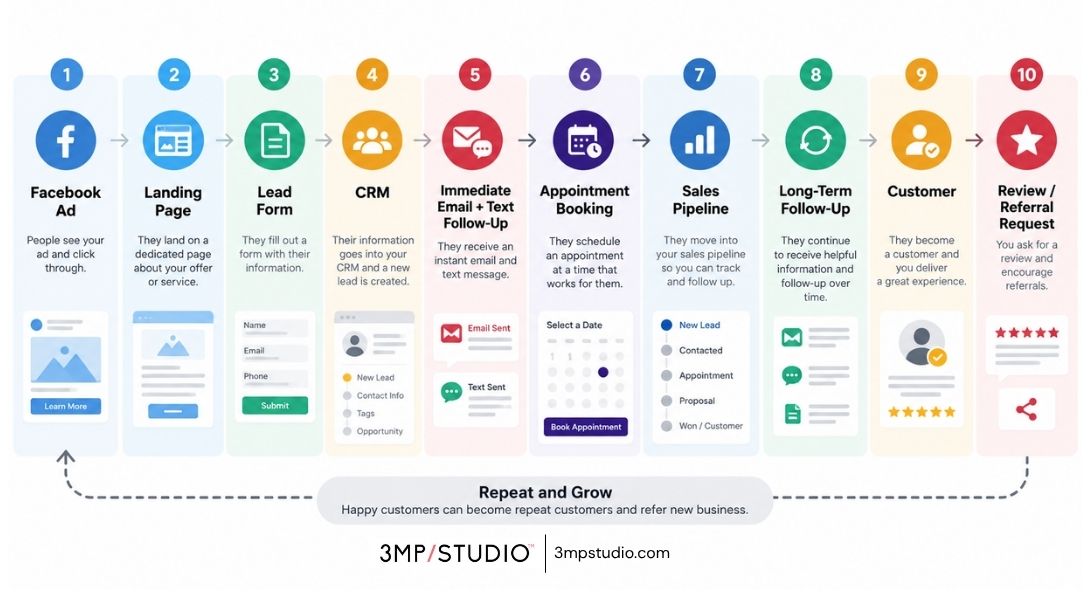
That’s the system you’re actually choosing software to support.
And suddenly the question isn’t simply:
Keap or GoHighLevel?
It’s:
How much of this system do I want one platform to handle?
Marketing Automation: Both Can Be Powerful
Let’s say someone requests information about your services.
Your system could automatically:
Send an immediate email.
Send a text message.
Notify your sales team.
Create an opportunity in your pipeline.
Wait 24 hours.
Check whether the prospect scheduled an appointment.
Follow up if they didn’t.
Move them into another campaign if they did.
Request a review after they become a customer.
Both platforms can automate significant portions of that journey.
The difference becomes more noticeable as your marketing ecosystem becomes more complicated.
If most of your automation revolves around CRM, sales, customer management, and follow-up, Keap can be a natural fit.
If your automation connects ads, landing pages, forms, calendars, SMS, pipelines, reputation management, and other marketing activities, HighLevel’s broader ecosystem becomes attractive.
Where GoHighLevel Gets Interesting:
Lead Generation
This is one of HighLevel’s biggest differentiators.
A business could potentially run:
Facebook Ad → Landing Page → Form → CRM → SMS → Email → Appointment → Sales Pipeline
without stitching together five different platforms.
That doesn’t automatically make the marketing better.
But it can make the technology behind the marketing simpler.
Fewer disconnected tools can mean fewer integration problems, fewer subscriptions, and fewer places where leads can fall through the cracks.
What About Agencies?
This is another major distinction.
HighLevel has been built heavily around agencies, consultants, marketers, and businesses managing multiple locations or accounts.
Depending on the plan, agencies can create separate sub-accounts for clients while keeping each client’s contacts, campaigns, pipelines, calendars, and marketing assets separated.
Higher tiers also introduce white-label and SaaS capabilities.
Keap, by comparison, is primarily designed around the business using the CRM itself.
That’s an important distinction if you’re evaluating these platforms for an agency rather than one individual business.
What About Price?
At the time of writing, Keap’s published pricing starts at $299/month, while HighLevel starts at $97/month, with additional HighLevel plans at $297 and $497 per month.
Looking at those numbers alone can be misleading.
Don’t Compare Subscription Prices. Compare Your Entire Technology Stack.
Imagine you’re currently paying separately for:
CRM
Email marketing
Landing pages
Appointment scheduling
SMS marketing
Reputation management
Automation software
Forms
Suddenly a $97, $297, or even $497 platform isn’t competing with one subscription.
It’s potentially competing with your entire stack.
The opposite can also be true.
If your business doesn’t need all those capabilities, paying for a large all-in-one marketing platform and dealing with the complexity that comes with it may not make sense.
HighLevel also has usage-based costs associated with some communication and AI services, so those costs should be considered as well.
The cheapest monthly subscription isn’t necessarily the cheapest system.
So, Which Type of Business Fits Each Platform?
Keap May Make Sense When…
- Your business primarily needs a strong CRM.
- Sales follow-up is a major priority.
- You want automation without necessarily rebuilding your entire marketing stack.
- Payments, invoicing, and customer management are important.
- You value implementation assistance and structured support.
GoHighLevel May Make Sense When…
- Lead generation is a major part of your marketing.
- You’re running Facebook or Google Ads and need automated follow-up.
- You want landing pages, forms, calendars, CRM, SMS, and automation working together.
- You’re an agency or consultant managing multiple businesses.
- You want to consolidate several marketing tools into one ecosystem.
- You expect to build more sophisticated marketing workflows.
Before You Choose Either One, Do This
Don’t start with the software.
Start with your customer journey.
Take a piece of paper or a whiteboard and map this:
Traffic → Lead → Follow-Up → Appointment → Sale → Customer → Repeat Business / Referral
Then ask:
- How are people discovering us?
- Where are we capturing their information?
- What happens immediately after they become a lead?
- Who follows up?
- What happens when they don’t respond?
- How do they schedule an appointment?
- How do we know where they are in the sales process?
- What happens after they become a customer?
Once you’ve mapped that process, choosing your technology becomes much easier.
Keap vs. GoHighLevel: The Bottom Line
Keap and GoHighLevel overlap considerably, but they’re approaching the problem from different directions.
Keap puts CRM, sales automation, customer management, payments, and business support near the center of the experience.
GoHighLevel expands further into the marketing ecosystem by combining CRM and automation with funnels, websites, calendars, communications, reputation management, and agency tools.
But here’s the part that matters more than either platform:
Neither Keap nor GoHighLevel can fix a broken marketing strategy.
Buying better software doesn’t automatically create better marketing.
The platform should come after you’ve determined how you want to attract leads, follow up with them, convert them into customers, and continue the relationship afterward.
Because ultimately, your CRM is just one part of a much bigger system.
Your CRM should support your marketing strategy, not become your marketing strategy.

As a Web Producer, I possess a diverse skill set that includes web design, graphics, marketing, software integration, and SEO. What I find fulfilling about my role is collaborating with fellow innovative marketers and assisting business owners and organizations in optimizing their digital footprint.